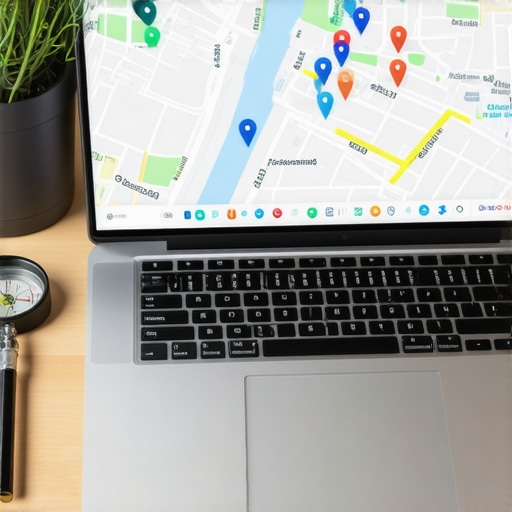
The smell of wet concrete always reminds me of a specific parking lot in a suburb of Chicago. I was standing there three years ago taking a burst of sixteen photos of a nondescript brick building. I was not there as a tourist. I was there because I spent three months fighting a hard suspension for a plumbing client whose listing was nuked simply because they shared a suite number with a defunct law firm. Google did not want proof of a van. They wanted proof of a utility bill under the exact GPS pin and a photograph of the physical mailbox that showed the suite number. This is the reality of the hyper-local layer. It is a world where the math of proximity meets the gritty physical world of storefronts and utility bills. A business listing is not just a profile. It is a proximity beacon in a complex spatial database. If your data is wrong, the beacon fails. If your beacon fails, your phone stops ringing. I have spent decades investigating map-spam and I have seen every trick in the book. I despise address rentals and keyword-stuffed business names. They are digital pollution. To survive in this ecosystem, you need a specific set of tools that go beyond basic search optimization.
The reinstatement war for a single suite number
Google Business Profile recovery and GMB reinstatement services rely on primary documentation like utility bills, business licenses, and photographic evidence of permanent signage. Reinstating a suspended profile requires a forensic approach to GPS coordinate salience and NAP consistency to prove the physical existence of the entity. The system is cold. It does not care about your revenue. It only cares about the signal. When that plumbing client lost his listing, he lost forty percent of his monthly leads in forty-eight hours. We had to dig into the forensic trace of his service area polygon. If you find yourself in this situation, you need a plan. You can how to recover a stolen or suspended business listing by following the strict evidence trail that the support team demands. It is a war of attrition. You submit the license. They ask for the lease. You submit the lease. They ask for a video walk-through. Every step is a test of your legitimacy.
The mathematical weight of a GPS coordinate
Proximity signals and local rank tracking are governed by the centroid theory and distance-weighted relevance. Every Google Maps pin is assigned a specific set of latitude and longitude coordinates that determine the search radius and visibility thresholds for near-me queries. The pin is everything. If the pin is slightly off the road, the algorithm might think you are inaccessible. I have seen rankings collapse because a business moved their pin to the back of their building to be closer to their actual office. Google saw the new coordinates and decided the business was now in a different neighborhood. You must how to update your pin location without triggering a verification loop or you risk a total visibility blackout. The physics of a three-mile radius shift are brutal. When you move, you are not just changing an address. You are changing your relationship with every competitor in the area. A competitor who was two miles away might now be four blocks away. This shifts the local justification triggers that Google uses to decide who gets the top spot. You are fighting for space in a crowded digital room.
“Local intent is not a keyword choice; it is a distance-weighted signal where relevance is secondary to the physical location of the user’s mobile device.” – Map Search Fundamental
Cleaning the historic citation debris
Local SEO services for cleaning historic citation spam focus on data scrubbing, NAP normalization, and the removal of duplicate listings from third-party directories and data aggregators. Old address data is a ghost that haunts your current rankings. Imagine a business that moved five years ago. If the old address still exists on twenty different niche directories, Google gets a mixed signal. It sees the new address on the website but sees the old address on an old Yellow Pages listing. This creates a trust gap. You need the simple way to clean up historic citation spam today before you try to build anything new. The process is manual and tedious. You have to hunt down the login credentials for sites you have not seen in a decade. You have to email support desks in different time zones. If you do not scrub this history, your citation consistency score will stay low. I have watched agencies spend thousands on new links while ignoring the toxic waste of their past campaigns. It is like trying to paint a house that is currently on fire. You have to put out the fire first.
The logic of the verification loop
GMB verification loops are triggered by frequent address changes, category swaps, or unusual activity patterns detected by the Map-Spam AI filters. Once you are in a loop, every update you make sends you back to the start. The system becomes suspicious. It starts looking for mismatched phone numbers in the secondary verification tier. If you have changed your business model, you likely need google maps ranking problems simple solutions to improve your local visibility to break the cycle. The loop is a defensive mechanism. Google wants to ensure that the person managing the listing is the actual owner. I once saw a business owner get stuck in a loop for six months because he kept changing his office hours by fifteen minutes every Tuesday. The AI flagged it as robotic behavior. We had to stop all updates for thirty days to let the profile settle. Only then could we successfully complete the video verification. It is about patience and precision. You cannot bully the algorithm into trusting you. You have to earn it through consistent, slow data patterns.
The kit for forensic review analysis
Fake review removal and local reputation repair requires IP address tracking, user profile auditing, and pattern recognition to identify VPN-based spam attacks and competitor sabotage. A local cafe owner called me at midnight because a competitor had dropped twenty 1-star reviews in an hour. We had to do a forensic audit of the user profiles. We looked at the review history of every account. If an account reviewed a plumber in New York and a cafe in London within the same ten minutes, we knew it was a bot. We presented this data to the spam team. You should check the process for removing legacy black hat footprints from your map listing to understand how to protect your brand. Reviews are more than just stars. They are behavioral signals. Google looks at the sentiment analysis and the keywords used in the review text. If a customer mentions your specific service and your city, that review has ten times the weight of a simple five-star rating. Real customers leave photos. They mention the name of the staff. They describe the physical space. These are the details that the AI looks for to verify authenticity.
Expanding the proximity circle beyond the building
Proximity-based ranking is limited by the physical centroid of the business but can be expanded through local entity signals, geo-tagged images, and service area optimizations. Most businesses only show up in the Map Pack for their own building. This is a common frustration. You are sitting at your desk and you see your business at number one. You walk two blocks away and you disappear. This is the proximity collapse. To fix this, you need the better way to track local proximity without spending a fortune using grid-based tracking tools. These tools show you exactly where your visibility drops off. You might find that you rank well to the north but not to the south. This tells you that you have a data gap or a competitor who is dominating that specific neighborhood. You can then target that area with location-specific content and localized backlinks. You are trying to stretch your digital shadow. It requires a constant feed of new, hyper-local data to stay relevant in the eyes of the machine.
Local Authority Reading List
- The 3 tools you actually need to monitor local search performance
- The exact tools used to audit local business profiles fast
- Why keyword stuffing is the easiest way to lose your map rank
- How to fix wrong business data without getting suspended
- The better way to track local proximity without spending a fortune
The authority migration of a changing domain
Local SEO domain migration involves mapping old location authority to new URLs while maintaining GBP website link integrity and JSON-LD schema continuity. When a business rebrands or changes its domain, it risks losing all its local equity. The map profile is tied to the old website. If the link breaks, the trust score drops. I have seen rankings fall off a cliff because an owner changed their URL and did not set up proper redirects. You must learn switching domains here is how to keep your google maps authority intact to avoid this disaster. The NAP-W (Name, Address, Phone, Website) cluster is a single unit in the eyes of Google. If one piece of the cluster changes, the whole unit is re-evaluated. This is why multi-location businesses often struggle. Their data is contradictory across fifty different pages. You need to simplify. You need to ensure that every location page is a clear, high-authority entity that provides real value to the user. Do not use thin content. Do not use generic templates. Every location has a story. Tell it.
“Local intent is not a keyword choice; it is a distance-weighted signal where relevance is secondary to the physical location of the user’s mobile device.” – Map Search Fundamental
Why your service area polygon is failing
Service Area Business (SAB) profiles must define specific zip codes or county boundaries within the Google Business Profile dashboard to avoid ranking suppression caused by overlapping service zones. Many contractors make the mistake of setting their service area to a hundred-mile radius. They think more is better. It is not. Google sees a massive service area and treats it as a weak signal. It prefers a tight, high-density polygon. If you are struggling to show up, you should fixing the radius problems that keep your business invisible by narrowing your focus. Focus on the neighborhoods where you actually have customers. Use GPS-tagged photos from those jobs. Upload them to your profile. This tells the algorithm that you are physically present in those areas. The AI analyzes the metadata of your uploads. It knows if a photo was taken at your office or at a job site ten miles away. Use that to your advantage. Stop trying to be everywhere. Be the dominant force in your own backyard first. The phone rings when you are the most relevant option in the smallest possible area.