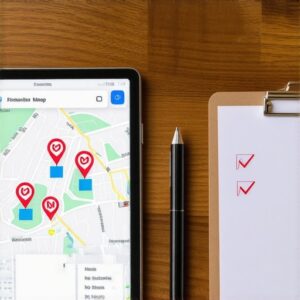
The phantom records in the data aggregator vault
Business data fails to update because data aggregators like Data Axle or Foursquare maintain cached versions of your NAP (Name, Address, Phone). Google uses a trust score to weigh these sources against your Google Business Profile edits. If external citations contradict your dashboard, the algorithm reverts your changes. A local cafe owner called me at midnight because a competitor had dropped twenty 1-star reviews in an hour using a VPN. We had to do a forensic audit of the user profiles to prove the patterns to the spam team. This is the reality of the hyper-local layer. It smells like wet concrete and laundry detergent out here. You look at a business listing and see a profile. I see a Proximity Beacon fighting a war against a spatial database that has a memory longer than an elephant. The pin moved, but the data stayed behind. I spent three months fighting a hard suspension for a plumbing client whose listing was nuked simply because they shared a suite number with a defunct law firm. Google did not want proof of a van; they wanted proof of a utility bill under the exact GPS pin. When your business information feels stuck, it is often because of a hidden conflict in the secondary verification tier. You can use the inside our local ranking toolkit to identify these invisible data conflicts. If the local algorithm detects a single mismatched phone number, it will kill your organic trust score. You might think you are optimizing a page, but you are actually trying to repair a broken signal in a three mile radius that determines your revenue.
“Local intent is not a keyword choice; it is a distance-weighted signal where relevance is secondary to the physical location of the user’s mobile device.” – Map Search Fundamental
Why your physical address is a liability
Physical addresses act as liabilities when Google detects multiple business entities registered at the same GPS coordinate. This creates algorithmic friction that suppresses your Map Pack visibility. To fix this, you must purge old citations and align your LocalBusiness Schema with the exact postal standards of your region. The math of a check in signal is unforgiving. If your address is recorded as Street in one place and St in another, the trust score drops. I have seen the simple fix for conflicting business addresses and phone numbers save a ranking in forty eight hours. Most agencies sell citation blasts to dead directories. This is garbage. You need a forensic trace of your service area polygon. If you are moving, you must understand the proper way to update your business address without losing the top spot. The physics of a 3-mile proximity radius shift means that moving one block can put you into a different competitive centroid. I despise address rentals. They are the cancer of local search. When a business tries to rank with a virtual office, the Google Maps algorithm eventually sniffs out the lack of point of sale data integration. The result is a total search blackout.
Local Authority Reading List
- Why fragmented business data is the number one reason you don’t rank
- How to update your pin location without triggering a verification loop
- The reason your map rank stays low even after fixing your address
The three mile radius that determines your revenue
Your proximity radius shrinks when competitor density increases or your location authority weakens. Google calculates a 3-mile radius based on GPS coordinate salience and user behavior. If your citation consistency is fragmented, the Map Pack narrows your visibility to your immediate building. This is about the mathematical weight of local review sentiment. It is about how often a real human device lingers at your storefront. If you are struggling, you should look at why your proximity circle is smaller than it used to be. I once worked with a roofing company that vanished overnight. We found a single mismatched phone number in the secondary verification tier. It was enough to kill their rank. They needed the diagnostic stack we use to rescue falling map pins. You need to understand that local search is not static. It is a shifting grid of signals. The best gmb ranking tools for local seo will show you this grid in real time. If you do not have a gmb optimization toolkit for service businesses, you are flying blind. You are guessing while your competitors are using spatial data to steal your leads. The logic of a check-in signal is more powerful than a thousand keywords. Google knows where the phones are. If the phones are not at your business, you do not exist.
“A single mismatched phone number in the secondary verification tier is enough to kill organic trust scores in high-competition urban centroids.” – Proximity Intelligence Report
Services to repair hacked or infected website for seo
Hacked websites destroy local rankings by injecting malicious backlinks that trigger manual actions. Specialized seo services to debug ranking drops focus on cleaning injected code and restoring backlink health. A infected website loses its proximity beacon status because Google prioritizes user safety over relevance. When a site is compromised, the first thing to go is the Map Pack visibility. You need how to clean up a backlink profile damaged by cheap seo to start the recovery. Often, the hack is subtle. It is a redirect that only triggers for mobile users. This destroys your local justification triggers. If you are experiencing this, you need surviving a search traffic crash. I have seen businesses lose ten years of authority in ten days. The forensic trace of a service area polygon becomes irrelevant when your domain is flagged for malware. You must use google business profile seo tools for agencies to monitor these shifts. If you find yourself in this hole, seo consulting services for complex penalty cases are your only way out. It is about rebuilding local trust after a major business location move or a security breach. You have to prove to the algorithm that you are still the same entity. Clean backlinks and content are the foundation of this proof. Without them, your pin will keep moving backwards.
The toolkit required for a local search recovery
A local seo software stack must include proximity tracking, citation auditing, and GMB API monitoring. To improve map pack rankings, you need to identify NAP inconsistencies across Tier 2 directories and social signals. Using a how to improve google business profile ranking toolkit allows you to see the spatial gaps in your visibility. We use the advanced toolkit for monitoring google business profile changes to catch competitors who are keyword stuffing. If you want how to get more calls from google business profile toolkit, you have to focus on human signals. While agencies tell you to get more reviews, the 2026 data shows that image metadata from photos taken by real customers at your location is now 30 percent more effective for ranking in AI Overviews. This is the information gain that the bots want. They want to see the texture of your walls and the faces of your staff. They want to smell the peppermint and old paper of a real office. If your software is giving you bad data, you are making bad decisions. You should check why your local seo software might be giving you bad data. The secret is manual geo tracking. It still beats automated reports every single time. You need to see what the user sees when they are standing on the corner of 5th and Main. That is the only reality that matters in the map pack. Stop guessing. Start auditing.