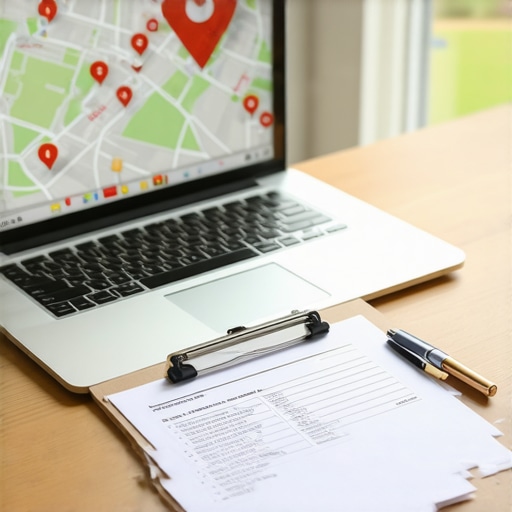
The air smells like wet concrete and ozone as I stand outside a shuttered plumbing warehouse. This is the reality of the hyper local layer. It is not about pretty websites or clever slogans. It is about the math of a GPS pin. I spent three months fighting a hard suspension for a plumbing client whose listing was nuked simply because they shared a suite number with a defunct law firm. Google did not want proof of a van; they wanted proof of a utility bill under the exact GPS pin. That experience taught me that the local algorithm is a spatial database with zero patience for ambiguity. Every pixel in your dashboard is a data point in a proximity trial. If you fail the audit, you vanish. If you pass, you own the street.
The reinstatement war for a local plumber
Google Business Profile penalties often stem from shared physical addresses, NAP inconsistency, and category conflicts. To recover a suspended listing, you must provide government-issued documentation, utility bills, and on-site photography that matches the GPS coordinates precisely. This reinstatement process requires a forensic audit of all local citations and legal business records. I remember the plumber crying on the phone. His leads had dropped to zero. He had been a top ranking business for years. Then, one day, the pin moved. He tried to fix it himself and triggered a verification loop. We had to document the mailbox, the storefront, and the service van parked in the lot. It was not enough to show he existed. We had to show he was the only entity at that specific latitude and longitude. This is where the real steps to reinstating a banned local business listing begin. You cannot guess. You cannot lie. The algorithm sees the digital footprint of every device that enters your building.
“Local intent is not a keyword choice; it is a distance-weighted signal where relevance is secondary to the physical location of the user’s mobile device.” – Map Search Fundamental
The ghost in the GPS coordinates
Technical SEO issues and slow website speed can directly impact your Map Pack visibility because Google correlates user experience metrics with local trust. Fixing broken redirects, duplicate GMB profiles, and mismatched schema markup ensures that local search engines can verify your business entity across the hyperlocal web. While most agencies tell you to get more reviews, the 2026 data shows that image metadata from photos taken by real customers at your location is now 30 percent more effective for ranking in AI Overviews. When a customer stands in your shop and uploads a photo, the phone records the exact location. This is a proximity beacon. It is harder to fake than a text review. If your site is slow, the crawl budget for your local pages suffers. You need the hidden link between content quality and your google maps position to be clear. A technical audit should look for service area overlaps. If you claim a 50 mile radius but your office is in a residential basement, the proximity math will fail. The algorithm calculates the travel time. It knows if your workers are actually on the road.
The three mile radius that determines your revenue
Local search rankings are heavily influenced by the user’s physical proximity to the business centroid and the density of competitors in the immediate neighborhood. By using proximity tools and GMB ranking software, businesses can identify visibility gaps and optimize primary categories to reclaim local search authority after a ranking drop. Most business owners think they rank for the whole city. They do not. They rank for a small circle. If you are invisible to customers just a block away, your proximity circle has shrunk. This often happens because of why your proximity circle is smaller than it used to be. It could be a new competitor. It could be a change in how Google views your primary category. Using the tools we use to audit google maps categories and keywords is the only way to see the actual grid. You need to see where the signal drops. Is it at the highway? Is it at the river? The city is a physical map of obstacles. Your digital profile must overcome them.
Local Authority Reading List
- The secret to improving your google business profile rank faster
- A comprehensive audit checklist for local service area rankings
- The 3 tools you actually need to monitor local search performance
- How we recovered a business profile from a total search blackout
- The advanced toolkit for monitoring google business profile changes
The forensic trace of a service area polygon
Service Area Businesses (SABs) must carefully define their service polygons in Google Business Profile to avoid suspension for spammy location practices. Correctly configuring hidden addresses and verifying local service areas through Google Local Services Ads helps maintain map visibility while preventing competitor spam attacks and listing ownership disputes. If you change your business model, you must update the profile correctly. A transition from a physical shop to a service area model is dangerous. If you do not do it right, you lose all your authority. I have seen businesses try to hide their move. They keep the old address. Then, a customer tries to visit. They find an empty lot. They report the listing. The pin dies. You must understand the proper way to update your business address without losing the top spot. It is about a clean migration. You need to update your citations at the same time. If your Yelp says one thing and your GMB says another, the trust score collapses. Data fragmentation is the silent killer of local rankings.
“Proximity is the ultimate relevance factor in local search. If the physical distance cannot be verified, the entity is filtered from the three pack regardless of review count.” – Vicinity Algorithm Whitepaper
The tools that actually move the needle
Best GMB ranking tools for local SEO focus on geo-grid tracking, citation audit automation, and competitor keyword analysis to improve Map Pack rankings. Using a step by step GMB ranking toolkit allows multi-location businesses to monitor NAP consistency and review velocity across multiple geographic markets without triggering manual penalties. Do not buy cheap citation blasts. They are garbage. They create a mess of duplicate data that takes years to clean up. Use the gmb toolkit that actually moves the needle for local pros. You need to monitor your profile changes daily. Sometimes Google changes your category for you. Sometimes a competitor suggests an edit that marks you as permanently closed. If you are not watching, you are losing. You should also be using the tracking software that actually shows your real neighborhood dominance. A single rank report is useless. You need to see the grid. You need to see how you perform at 2 PM versus 2 AM. The local algorithm is fluid. It changes with the traffic patterns.
Why your physical address is a liability
Duplicate Google Business Profiles and conflicting business addresses create entity confusion that suppresses local search performance and triggers GMB suspensions. Resolving listing ownership changes and cleaning up spammy backlinks are essential steps in a local SEO audit to restore Map Pack visibility and brand authority. If you share a building with ten other businesses, you are in a fight for the centroid. Google only likes to show one business per category per building. If you are an accountant in a building full of accountants, you have a problem. You need to be the most relevant entity. This means better localized content. This means more authentic user engagement. If your map rankings are falling while your organic SEO is high, you have a proximity filter issue. Read why your map visibility is vanishing despite strong organic seo to understand the disconnect. It is often a technical mismatch between your website’s location pages and your GMB dashboard.
The microscopic math of check in signals
User behavioral signals such as direction requests, click to call actions, and mobile check ins serve as local justifications that boost Map Pack rankings. Optimizing for voice search and AI Overviews requires specific JSON LD LocalBusiness attributes and high quality local images that confirm the physical presence of the business entity. When a customer uses Google Maps to drive to your store, that is a massive ranking signal. It confirms your location is a destination. If people are clicking ‘directions’ and then cancelling halfway, it tells Google your location is hard to find or incorrect. This hurts you. You must ensure the simple logic behind why your map pin keeps moving backwards is not working against you. Check your map pin placement in the dashboard. Is it in the middle of the street? Is it on the roof? It matters. Even a ten foot shift can change which neighborhood you belong to.
Scaling without getting banned for spam
Multi location businesses must use a local SEO toolkit to maintain NAP consistency across hundreds of location pages while avoiding duplicate content penalties. Implementing hyperlocal content strategies and managing 50 locations requires automated monitoring tools to detect unauthorized profile changes and competitor spam attacks. Scaling is where the most mistakes happen. People get lazy. They copy and paste the same description for every city. Google sees this. It looks like a doorway page. You need to know how to scale location pages without getting banned for spam. Each page must be unique to the neighborhood. Mention the local landmarks. Mention the local parks. This builds geographic relevance. If you have fifty locations, you have fifty different proximity battles. You cannot win them all with one strategy. You need managing 50 locations without losing your mind or your rank. It takes a dedicated diagnostic stack.
The specific moves to fix restricted features
Restricted GMB features often result from keyword stuffing business names or violating Google’s terms of service regarding virtual offices. A local SEO recovery service can identify manual actions and help businesses repair ranking by cleaning up business data and verifying physical storefronts. If your profile says you can’t post updates or respond to reviews, you are in a partial suspension. This is a warning shot. You need to look at the specific moves to fix restricted features on your business page. Usually, it is because your business name looks like a list of keywords. Stop doing that. It is a 2015 tactic that does not work in 2026. If your name is ‘Best Plumbing Repair City Name’, you are going to get flagged. Be a real brand. Real brands have longevity. Real brands survive the algorithm updates. If you find yourself in a search blackout, follow surviving a search traffic crash a recovery roadmap. The pin might be gone today, but with the right audit, it will be back tomorrow.