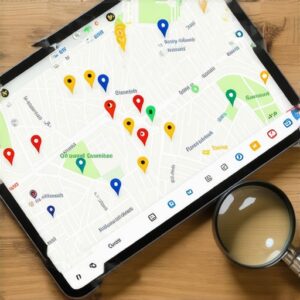
The air smells like wet concrete and ozone as the rain hits the pavement outside a small plumbing shop in a crowded industrial park. I am looking at a storefront through my lens, but what I am really seeing is a glitch in the database. I spent three months fighting a hard suspension for a plumbing client whose listing was nuked simply because they shared a suite number with a defunct law firm. Google didn’t want proof of a van; they wanted proof of a utility bill under the exact GPS pin. This is the reality of the hyper-local layer. It is not about keywords or meta tags; it is about the physical forensic evidence of a business existence. If your data is not grounded in the dirt of your location, the algorithm will treat you like a ghost. The struggle for a top three position in the Map Pack is often a war of attrition against hidden technical errors and mismatched location signals.
The ghost in the GPS coordinates
Google Business Profile rankings are driven by proximity, relevance, and prominence signals that calculate the distance between a user mobile device and the business centroid. The algorithm uses latitude and longitude coordinates to verify the authenticity of a service area before deciding which pin to display in the local pack. Most business owners ignore the microscopic math of their pin placement. They assume that an address is enough. It is not. If your pin is located in the middle of a parking lot instead of the front door of your office, you are losing proximity weight. This is a common Google Maps ranking problem that requires manual adjustment. I have seen rankings jump by fifty positions simply by moving a pin thirty feet to the left. The algorithm is obsessed with the physical path a customer takes to find you. When you use map data tools, you begin to see that proximity is a shifting variable. It changes based on the density of the neighborhood and the speed of the local traffic. A three mile radius in a rural town is a different mathematical beast than a three mile radius in Manhattan. To win, you must understand the simple math behind ranking which dictates that the closer you are to the user, the less content you need to outrank a giant competitor.
“Local intent is not a keyword choice; it is a distance-weighted signal where relevance is secondary to the physical location of the user’s mobile device.” – Map Search Fundamental
Why your physical address is a liability
A physical address can trigger a hard suspension if the business model conflicts with Google guidelines or if the building has a history of spam. Shared office spaces, virtual addresses, and industrial parks with multiple suites are high risk zones for local search filters. The algorithm looks for signs of life. It looks for unique utility bills and signage. Many contractors find themselves recovering a service area profile after a failed attempt to use a virtual office. Google wants to see a real footprint. If you are a home-based business, you face even tougher hurdles. I have spent weeks getting home-based businesses back on Google after a ban. The key is documentation. You need a lease. You need a business license that matches your GPS pin exactly. If there is a single digit mismatch in your suite number, the trust score collapses. This is why fixing conflicting business addresses is the first step in any real audit. You cannot build a tower on a swamp of bad data. If you have recently moved, you might be recovering local traffic after an address change, which requires a full cleanup of every legacy citation across the web. The old address acts like a lead weight, pulling your new location down because the algorithm sees two different entities in the same space.
Local Authority Reading List
- Why some listings rank higher with less content
- Reversing a hard suspension for business models
- How to fix low map rankings and dominate
- Documentation needed to fix a suspension fast
- Software that helps you move into the top 3
The three mile radius that determines your revenue
Service area boundaries are mathematical polygons that tell Google where your business is capable of fulfilling a customer request in real time. If you draw your service area too wide, the algorithm flags you as a spammer; if it is too narrow, you lose visibility to nearby leads. The physics of local search dictates that your ranking power drops as you move away from your primary pin. This is the vicinity effect. You might notice why your service area pages are failing to move the needle. It is usually because the website content does not match the GMB service area settings. The two must be in perfect harmony. Use specific tools to audit categories and ensure you are not over-optimizing. If you are trying to reach multiple neighborhoods, you need a multi-location strategy that does not involve creating duplicate listings. Duplicates are the fastest way to get a permanent ban. Instead, focus on scaling location pages on your website that feed unique signals back to your primary profile. Every check-in from a technician in the field acts as a proximity signal. Every photo uploaded by a customer at their home within your service area strengthens the bond between your profile and that specific neighborhood. This is the behavioral zooming that modern SEO requires.
The glitch in the storefront data
Inconsistent directory listings and fragmented NAP data create a trust deficit that prevents a business from entering the top three map results. Google uses a verification loop where it checks third-party sites like Yelp, Bing, and local industry directories to confirm your identity. If your business name on Yelp has an extra keyword but your GMB profile is clean, the algorithm gets confused. This is why fragmented business data is the primary reason for ranking stagnation. You must audit every citation. I often see cases where an amateur SEO agency has stuffed the business name with city names. This might work for a week, but then the filter kicks in. You are better off cleaning up your business name and returning to reality. Does changing the name restore rankings? Yes, restoring your real name often triggers a re-indexing that clears the spam filter. You should also be wary of cheap international backlinks that have nothing to do with your town. A plumber in Chicago does not need a backlink from a fashion blog in Singapore. Those links are toxic. You need to replace toxic links with citations that actually matter to your local community. Consistency is the foundation of the entire map ranking system.
“Relevance is the result of a dense web of local signals where the business entity is consistently linked to a specific geographic boundary across multiple authoritative datasets.” – Spatial Intelligence Report
Winning the war against map pack spam
Competitor spam attacks and fake review blasts are forensic events that require immediate reporting and data-backed appeals to the Google search team. If a competitor suddenly appears at the top with twenty reviews in a single day, they are likely using a click farm. You need to know how to fight competitor spam without getting your own profile flagged. It involves documenting the patterns. Are the reviewers located in the same city? Do they have a history of reviewing other businesses in that area? If not, it is a clear violation. Sometimes the attack is internal. You might find a malicious script on your website that is redirecting local traffic to a competitor. This happens more often than people realize. Your security is part of your SEO. This is why a security plugin is an essential part of your toolkit. If you are hit by a torrent of bad links, you must follow a guide to disavowing the right links. Do not just delete everything. You need to be surgical. You have to identify and purge spammy links while keeping the authority that you have worked hard to build. A negative SEO attack can be neutralized if you act fast and provide the right evidence to the webspam team.
The future of AI overviews in local search
AI-driven search engines now prioritize image metadata and customer behavioral signals over traditional keyword density in the primary business description. The machine learning models are looking for proof of high-quality interactions. They look at how long a user stays on your profile and whether they click the call button. If you have a low call profile, it is a signal that your business is not meeting the user needs. You need to use the right toolkit to turn those views into actions. This includes using advanced monitoring tools to see what your competitors are doing in the shadows. AI overviews also value category precision. If you are in a crowded market, the exact category settings can be the difference between being buried on page two or dominating the pack. Do not guess. Use search tools to find the best primary categories. Most businesses fail because they choose too many secondary categories, which dilutes their topical authority. Keep it focused. Keep it local. The more specific your data is, the more likely the AI will cite you as the definitive answer for a local query. Your reputation with Google is a living score that requires daily maintenance. The pin moves. The algorithm shifts. You must remain vigilant.